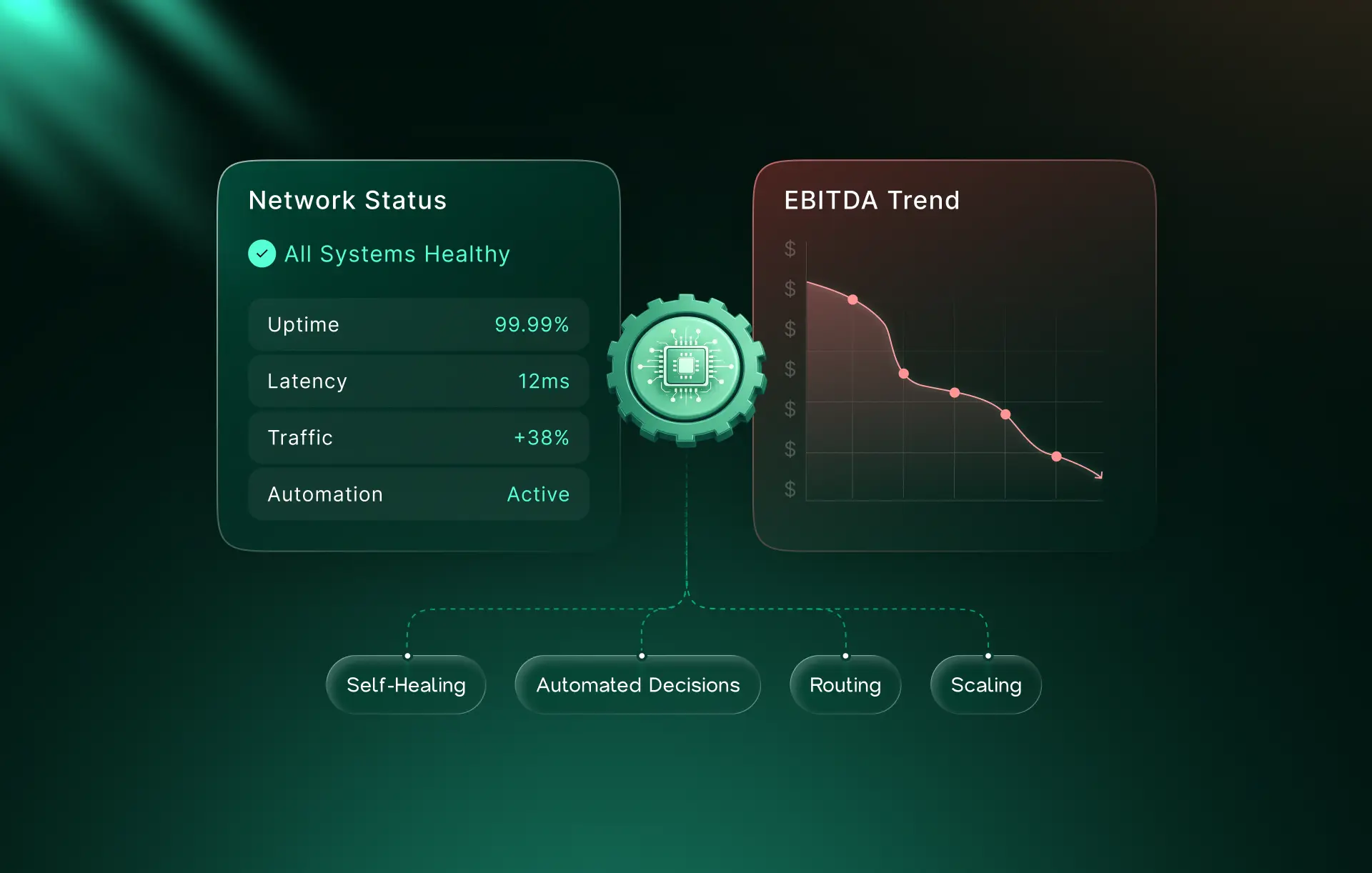



The telco execution gap refers to the disconnect between exposed network capabilities and their ability to generate repeatable, usage-based revenue. While APIs technically exist, they fail to operate as commercial products — resulting in stalled adoption and minimal monetization.
Why Are Network APIs in Telecom Still Not Generating Revenue?
Telecom operators today are not short on technical capability.
Network APIs are live.
5G core exposure is real.
Developer portals exist.
Yet despite years of investment, telecom API monetization remains marginal for most operators.
This disconnect highlights a deeper industry issue: the gap is no longer about technology maturity. It is about execution.
While hyperscalers have turned APIs into multi-billion-dollar ecosystems, most telecom operators remain stuck in pilots, proofs of concept, and press releases. This persistent disconnect between capability and commercial outcomes is what defines the telco execution gap—and it is quietly blocking one of the industry’s most promising growth opportunities.
Industry momentum around open network APIs has accelerated significantly. However, reported outcomes remain experimental rather than recurring. This reinforces a critical truth: the bottleneck is not exposure—it is commercialization.
What Are Network APIs in Telecom, Really?
Network APIs in telecom expose core network capabilities—such as location intelligence, authentication, quality of service, billing, and messaging—to external developers and enterprises.
Instead of treating the network as a closed, internal asset, APIs allow telecom capabilities to be consumed programmatically, much like cloud services. In theory, this transforms telecom infrastructure into a telecom API platform.
In practice, however, monetization remains elusive—not because these APIs lack value, but because they are rarely delivered as APIs as products.
Why Has Telecom API Monetization Failed to Scale?
Telecom API monetization has been discussed for over a decade, yet results have consistently underperformed expectations.
The issue is not market demand. Enterprises increasingly seek network-native capabilities—such as identity verification, latency guarantees, and real-time policy control—that cloud providers cannot fully replicate.
The problem lies in execution.
Most telecom APIs are technically exposed but not productized. Commercial models remain rigid or unclear. Onboarding is slow and fragmented. Support feels enterprise-grade rather than developer-centric. As a result, APIs exist—but adoption stalls. (Explore why APIs only generate revenue when they’re treated as products, not interfaces.)
In successful monetization models, the economic buyer is rarely a generic “developer.” Revenue is driven by enterprises embedding telecom APIs into customer-facing applications, while developers act as the adoption channel—not the buyer.
Where Does the Telco Execution Gap Actually Exist?
The execution gap emerges between network exposure and commercial usability.
Telecom operators prioritize standards, compliance, and internal readiness. Developers and enterprises care about speed, documentation, predictable pricing, and frictionless integration.
This misalignment turns powerful network APIs into underused technical assets instead of scalable revenue engines.
Internally, API initiatives often sit between network, IT, and commercial teams, with no single owner accountable for adoption or revenue. This diffused ownership slows decisions and weakens outcomes.
How 5G API Monetization Changes the Stakes?
5G API monetization introduces something earlier generations could not: network differentiation as a service.
With 5G, APIs can expose latency guarantees, dynamic QoS, slicing awareness, and real-time policy control. These are not abstract features. In industries like fintech, gaming, healthcare, logistics, and autonomous systems, guaranteed latency and network-aware routing directly affect transaction success and user experience.
This turns network performance into a billable capability, not a background utility.
However, without disciplined execution, 5G APIs risk repeating the same monetization failures seen in 4G—strong capability, weak revenue.
Why Are Developers Avoiding Telco APIs?
Developer adoption is the clearest indicator of execution failure.
Most telecom APIs struggle because onboarding takes weeks instead of minutes. Documentation is written for network engineers rather than builders. Sandbox environments are limited or unreliable. Pricing lacks transparency.
Compared to cloud platforms, telco APIs feel complex, slow, and uncertain—even when the underlying capability is superior. This perception suppresses adoption and directly limits telecom API monetization.
What Role Does a Telecom API Platform Play in Monetization?
A developer portal alone does not create a platform.
True monetization requires an operational and commercial layer that connects network exposure to pricing, policy, billing, and lifecycle management.
This is where AI-driven telecom operations quietly remove friction across onboarding, pricing, billing, and lifecycle execution.
A mature telecom API platform standardizes exposure, simplifies onboarding, enables usage-based billing, provides analytics, and supports developers at scale. Without this layer, network APIs remain fragmented initiatives rather than repeatable revenue products. (See how API-first stacks separate scalable platforms from fragmented exposure experiments.)
From Network APIs to Revenue: What Actually Works
Operators that generate real API revenue follow consistent patterns.
They start with use cases, not capabilities.
They design APIs as products, not interfaces.
They price for consumption instead of contracts.
They automate onboarding and support.
They embed APIs into existing enterprise workflows.
Revenue does not come from exposing more APIs.
It comes from making APIs easier to buy, easier to use, and easier to scale.
The TelcoEdge POV: Closing the Gap Between Capability and Cash
Telecom operators already own the hardest asset—the network.
Those who close the execution gap move from one-off API deals to repeatable, usage-driven revenue. This shift signals that APIs have evolved from experimentation into core commercial infrastructure.
At TelcoEdge, we see network APIs not as side initiatives, but as foundational products. Operators that treat APIs as products—supported by platforms, pricing, and execution discipline—unlock growth without additional spectrum, towers, or infrastructure debt. (Understand why operators monetizing APIs successfully are evolving into software-led platforms.)
Because the real value of a network is no longer measured by how much traffic it carries, but by how effectively it converts capability into revenue.
Across operators that successfully monetize APIs, the pattern is consistent: APIs are owned by product teams, priced dynamically, and integrated into enterprise workflows — not treated as network extensions.