

For more than a decade, telecom modernization has been defined by a single idea: break the stack apart. Monolithic BSS systems were slow to evolve, difficult to upgrade, and tightly coupled to vendor roadmaps. The response was composability. Operators began decomposing billing engines, mediation layers, catalog services, policy engines, and customer systems into smaller modules connected through APIs.
In theory, this promised agility. New capabilities could be introduced without replacing the entire stack. Vendors could be swapped independently. Innovation could move faster.
Technically, that vision worked. But something else happened along the way. Many operators now run stacks that are more modular than ever yet harder to control, harder to reason about, and increasingly expensive to operate. The problem is not modularization itself.
The problem appears when modular systems behave independently.
The Hidden Trade-off of Composable Systems
Composable BSS architectures distribute responsibility across many components.
A modern telecom stack may include:
- independent catalog services defining product logic
- real-time charging systems rating usage
- mediation platforms transforming CDR streams
- API gateways exposing capabilities to partners
- orchestration layers managing service flows
- analytics platforms guiding decisions
Each component performs its job well. Each exposes APIs. Each can evolve independently. What becomes difficult is controlling how all of those decisions interact. When logic is distributed across dozens of services, behavior stops being deterministic. It becomes emergent.
The system still functions. Orders process. Charges apply. APIs respond. Yet outcomes begin to vary depending on timing, orchestration paths, or integration sequencing. The system works, but not always in the same way twice.
That is where operational entropy begins.

Why Composable BSS Often Increases Operational Entropy
In distributed systems, entropy rarely appears as outages. It appears as divergence. Two customers purchase the same product but receive slightly different service flows. The same usage event travels through different mediation paths depending on timing. Promotional logic executes differently under load compared to normal conditions. None of these behaviors break the system. But they create unpredictability.
Operators begin to discover that modular flexibility introduces new forms of operational complexity:
- more services participating in each transaction
- more decision points across the stack
- more dependencies across teams and vendors
- more surfaces where logic can diverge
As systems grow, tracing the full lifecycle of a transaction becomes increasingly difficult. The issue is not lack of visibility. Modern stacks generate enormous volumes of telemetry. The real challenge is fragmented responsibility.
APIs Expose Capability. They Do Not Guarantee Product Behavior
Operator Scenario: How Composable Systems Create Revenue Conflicts
Consider a mid-sized MVNO operating across two carrier partners and offering bundled digital services to enterprise customers. Over the past few years, the operator modernized its stack aggressively. The legacy BSS was broken into modular services: a new product catalog, a real-time charging platform, an API gateway for enterprise integrations, and a cloud-based mediation layer processing carrier CDRs.
Technically, the system performed well. New offers could be launched faster. Enterprise partners could integrate through APIs. Usage events were processed in near real time.
Yet operational teams began noticing a different pattern.
Usage recorded by the carrier mediation layer did not always match the usage rated by the charging engine. Promotional logic configured in the catalog occasionally applied differently depending on the service activation path. Enterprise partners integrating through APIs sometimes triggered charging flows that bypassed specific billing validation rules. None of these issues were severe enough to break services. But they created a growing reconciliation problem.
Finance teams started seeing discrepancies between rated usage, billed revenue, and partner settlements. Customer care handled an increasing number of billing disputes from enterprise clients whose internal usage logs did not align with invoices. The technical teams investigated and discovered something familiar in composable environments.
Each system behaved correctly within its own boundary:
- the mediation layer processed raw carrier CDRs accurately
- the charging system applied rating logic as configured
- the product catalog enforced offer rules
- the API gateway handled partner requests correctly
But the decision logic connecting those systems was fragmented. Different service flows triggered slightly different execution paths. Under load or timing variation, the sequence of events sometimes changed. Over time, those variations created subtle inconsistencies in how usage was rated and billed. From a systems perspective, everything was operational.
From a financial perspective, the operator was dealing with recurring revenue reconciliation issues and rising operational overhead. The problem was not a faulty component. It was the absence of clear behavioral governance across the stack.
Why This Scenario Is Increasingly Common
As telecom stacks become more modular, operators often introduce new components faster than they introduce behavioral guardrails. Each system evolves independently. Integration logic expands. Automation accelerates execution. Without a shared behavioral framework, the stack becomes technically flexible but operationally fragile.
For MVNOs and B2B2X operators that rely heavily on partner integrations and usage-based charging, this fragmentation can directly affect revenue accuracy and settlement integrity. Modern telecom systems rarely fail outright. More often, they drift.
Why Leaders Are Rethinking Platformization
This is why many operators are now shifting from pure composability toward platform governance models. Instead of focusing only on modular components, they are introducing system-level controls that define:
- how decisions propagate across services
- which system has final authority over rating or settlement logic
- how transaction flows are traced end-to-end
- how economic outcomes are validated before billing
In other words, platformization is becoming less about how many services exist and more about how consistently those services behave together. Another assumption behind BSS modernization is that APIs automatically convert capabilities into products. Expose network functions through APIs. Publish developer portals. Enable partners to integrate directly. The expectation is that monetization will follow. In reality, many telecom API programs struggle to move beyond pilots.
The reason is simple. APIs expose internal capabilities, but products require controlled behavior.
For a partner to build on a telecom capability, several things must remain predictable:
- how the service behaves under load
- how pricing is applied
- how usage is rated and billed
- how SLAs are enforced across environments
If each layer of the stack handles these behaviors independently, integration becomes uncertain. Partners then experience something telecom teams know well. What appears simple in architecture diagrams becomes complex in production. APIs alone do not solve this problem. Products require coherent behavior across the entire stack. (Explore why API-first strategies often fail without system control.)
Integration Velocity Does Not Guarantee System Stability
One of the main goals of composable architectures is faster integration.
In many cases, integration velocity does improve. New components can be deployed quickly. Vendors can be replaced with minimal disruption. Capabilities can be added without rewriting the stack. But integration speed and operational stability are not the same metric. When new components are added frequently without strong behavioral control, decision paths multiply.
A single customer action may involve:
- product catalog logic
- orchestration rules
- charging decisions
- partner API calls
- billing system reconciliation
Each layer may make its own assumptions. Over time, the stack evolves into a system where behavior is technically correct but increasingly difficult to predict.
That is when modernization stops delivering operational advantage.
Fragmented Decision Paths Create Hidden Cost
Most modernization initiatives focus on technical efficiency. They measure scalability, deployment velocity, and API availability. The most expensive effects appear elsewhere.
When decisions are fragmented across services, operators begin to experience:
- inconsistent rating outcomes
- reconciliation complexity between charging and billing layers
- increased manual intervention during disputes
- delayed detection of usage discrepancies
- operational teams spending more time tracing transactions than delivering services
These issues rarely appear as outages. They appear as recurring operational overhead. In distributed stacks, small inconsistencies compound quickly. (See how system fragmentation drives hidden telecom costs.)
Why Leaders Must Design Behavioral Guardrails
Composable systems work best when flexibility is balanced with strong behavioral constraints. Without these guardrails, distributed decision logic becomes difficult to govern. Telecom leaders increasingly recognize that modernization must include:
Defined decision ownership
Every automated action must have a clear source of authority rather than multiple services performing overlapping functions.
Consistent policy enforcement
Rules governing pricing, service activation, and settlement must apply uniformly across components.
Transaction traceability
Operators must be able to follow a customer action or usage event through every system that touches it.
Controlled decision boundaries
Not every service should make independent decisions about behavior or pricing.
These guardrails allow composability to deliver agility without sacrificing control.
Why Platformization Is About Behavior, Not Just Components
The next phase of telecom modernization is shifting from composability to platformization. At first glance the concepts seem similar. Both emphasize modularity and interoperability. The real difference lies in behavior. A composable stack focuses on components. A platform focuses on how those components behave together.
In a true platform model:
- policies apply consistently across services
- economic signals reach operational systems
- decision paths remain observable and explainable
- integrations extend capability without fragmenting logic
Platformization does not reduce modularity. It introduces behavioral discipline. ( Understand how modern telecom stacks are structured for control.)
Operator Diagnostic: 5 Signs Your Composable BSS Is Creating Operational Entropy
Many telecom stacks today appear healthy on the surface. Orders process successfully. APIs respond quickly. Billing cycles close on time. But composable systems can begin drifting long before visible failures occur. Operators reviewing modernization outcomes should watch for the following signals.
1. Billing Reconciliation Is Increasingly Manual
Revenue assurance teams spend more time reconciling CDRs, charging outputs, and invoices across multiple systems.
Discrepancies are not large enough to trigger system alerts, but they appear frequently enough to require investigation. This often indicates that rating logic, mediation flows, and billing validation are operating with slightly different assumptions.
2. Customer Service Handles More Usage Disputes
Enterprise and wholesale customers begin raising billing questions about usage records, bundle application, or settlement calculations. Internally, the systems appear correct. Externally, customers see inconsistencies between their usage logs and the final invoice. This usually signals fragmented decision paths across catalog logic, charging systems, and billing engines.
3. New Product Launches Require Cross-System Adjustments
Every new tariff or digital service requires changes across multiple platforms: catalog, charging, mediation, billing, and partner APIs. Launch cycles remain technically fast, but operational teams must coordinate across several systems to ensure the service behaves correctly. When product logic is distributed too widely, small configuration differences can lead to unpredictable behavior.
4. Transaction Tracing Becomes Difficult
Operations teams struggle to trace a single customer event across the stack. A usage session may pass through mediation, charging, orchestration, billing validation, and analytics pipelines. Each system logs its own activity, but reconstructing the full sequence of decisions requires manual correlation. This lack of traceability often hides the early signs of operational drift.
5. System Changes Create Unexpected Downstream Effects
Minor configuration changes in one system occasionally produce unexpected results elsewhere. A catalog update may affect rating logic. A new API integration may alter billing workflows. A partner integration may trigger alternative service activation paths.
These effects rarely appear during testing but emerge in production when real traffic interacts with distributed decision logic.
Why These Signals Matter
None of these conditions indicate a broken system. They indicate a system whose behavior is no longer fully governed. Composable architectures make telecom stacks more flexible. But flexibility without behavioral guardrails can introduce subtle divergence across services. Over time, that divergence creates operational overhead, reconciliation complexity, and hidden cost.
The goal of modernization is not simply modularity. It is predictable system behavior at scale.
How Leading Operators Are Responding
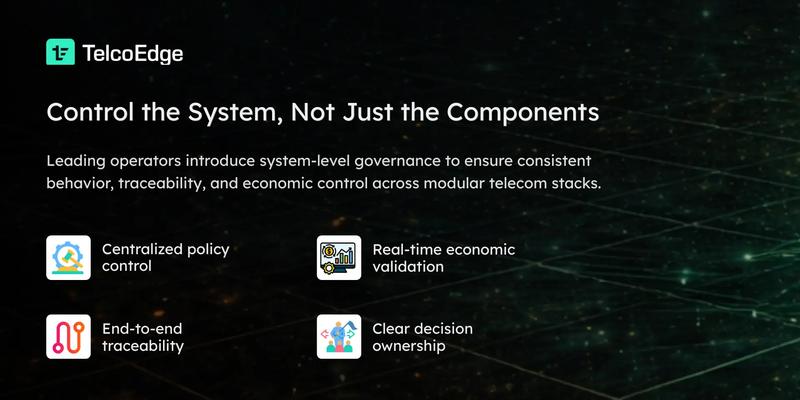
Operators addressing these challenges are beginning to introduce system-level governance across modular stacks.
This includes:
- central policy frameworks that apply across services
- consistent transaction tracing across operational systems
- economic validation of usage before billing cycles close
- defined authority for pricing, settlement, and charging decisions
These controls allow composable architectures to remain flexible while ensuring the stack behaves consistently.
The TelcoEdge Perspective
Modern telecom stacks will continue to become more modular. The industry has already moved beyond monolithic systems. But modularity alone does not guarantee operational clarity. Without behavioral guardrails, composable systems drift toward fragmentation. Decisions become distributed. Costs become harder to trace. Monetization becomes inconsistent. At TelcoEdge, we believe modernization must go beyond decomposing infrastructure.
Every system decision triggered by automation, orchestration, or AI must remain consistent, traceable, and economically aware. In modern telecom, the hardest problems are rarely caused by systems that fail. They are caused by systems that work but behave unpredictably.
Composable BSS architectures unlock flexibility. They also distribute decision logic across the stack. Without clear behavioral governance, modular systems introduce operational entropy that is difficult to detect and expensive to manage. The future of telecom modernization will not be defined by how many components a stack contains.
It will be defined by how consistently those components behave together.