

Inside the Stack: Designing for Ops Calm, Not Ops Chaos
Most telco backends aren’t built for calm.
They’re built for coverage.
Everything works — eventually — if your ops team learns to fight fires fast enough.
But here’s the thing:
Should ops really be your firefighting squad?
Or should they function as your control tower?
Because the stack they work on daily — it’s either a launchpad or a landmine. And for far too long, the industry has settled for the latter.
Legacy BSS = Beautiful Outside, Messy Inside
The legacy telco model is often romanticized.
Big dashboards. Complex layers. A solution for every process.
But what does that actually look like for the people behind the curtain?
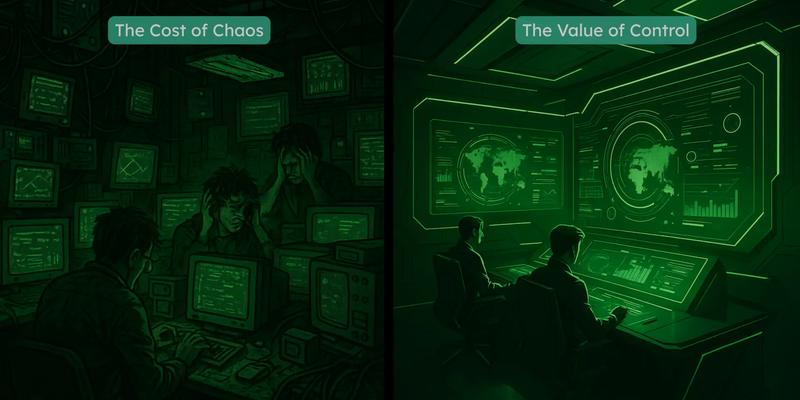
Is it normal to open 9 tabs to fix a single issue?
Or watch tickets fly between tools like a pinball machine?
To train teams not to avoid chaos — but to navigate it?
These aren’t features.
They’re friction systems — and they cost you more than just operational time. They cost money. They cost momentum. They cost morale.
So, the real question became:
Why are we still building for the illusion of control… instead of control itself?
At TelcoEdge, We Asked a Different Question
What if ops didn’t have to adapt to clunky backend systems?
What if backend systems were designed to adapt to them?
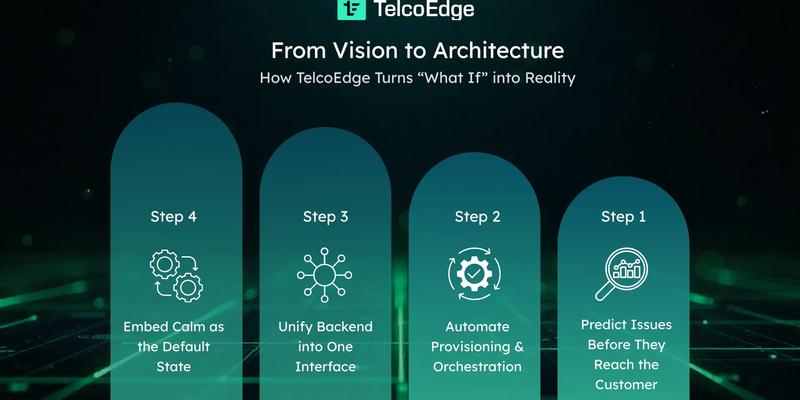
What if your NOC team could catch issues before customers ever reached support?
What if provisioning didn’t require window-hopping — but instead flowed like a single, uninterrupted system?
What if calm wasn’t the reward at the end of a firefight… but the default operating state?
That question — and its implications — became our north star.
Calm is a Product Feature. And We Designed for It.
We weren’t interested in building another BSS platform with shiny dashboards and underwhelming realities.
We wanted to build a backend that ops teams wouldn’t dread logging into — a system that earned their trust.
So we architected TelcoEdge from the inside out, based on a single principle: calm is not a UX choice, it’s a product outcome.
We unified data streams so ops wouldn't tab-hop to stitch together a story.
We built trigger-based automations so the system anticipates rather than reacts.
We implemented low-code flexibility to match the evolving pace of real teams — without the delay of a dev sprint.
And we made no-ticket flow design the product default — because the goal isn't just fewer tickets. It's none.
This wasn’t about compliance.
It was about control, clarity, and confidence — by design.
Calm Isn’t Soft. It’s Strategic
In telecom, the word “calm” can be misunderstood.
People associate it with passivity, with taking things slow.
But operational calm isn’t passive.
It’s the result of speed, structure, and foresight.
When your backend is built for calm, outages are predicted before they hit.
Support loads drop without relying on human escalation.
Provisioning speeds up without increasing risk.
Debugging doesn’t need war rooms — because visibility is already in place.
Calm isn’t the opposite of urgency.
It’s the strategic layer that ensures urgency never becomes your norm.
From Chaos Managers to Strategic Operators
Here’s what changes when ops teams stop reacting and start operating.
They begin building sharper alerts.
They generate smarter reports.
They improve configurations not just to patch issues, but to optimize flows.
They stop being labeled as “support.”
They start becoming your competitive edge.
TelcoEdge wasn’t built to reduce tickets.
It was built to **unlock operators.
Because when your backend respects the team running it, everything downstream gets faster, clearer, better.