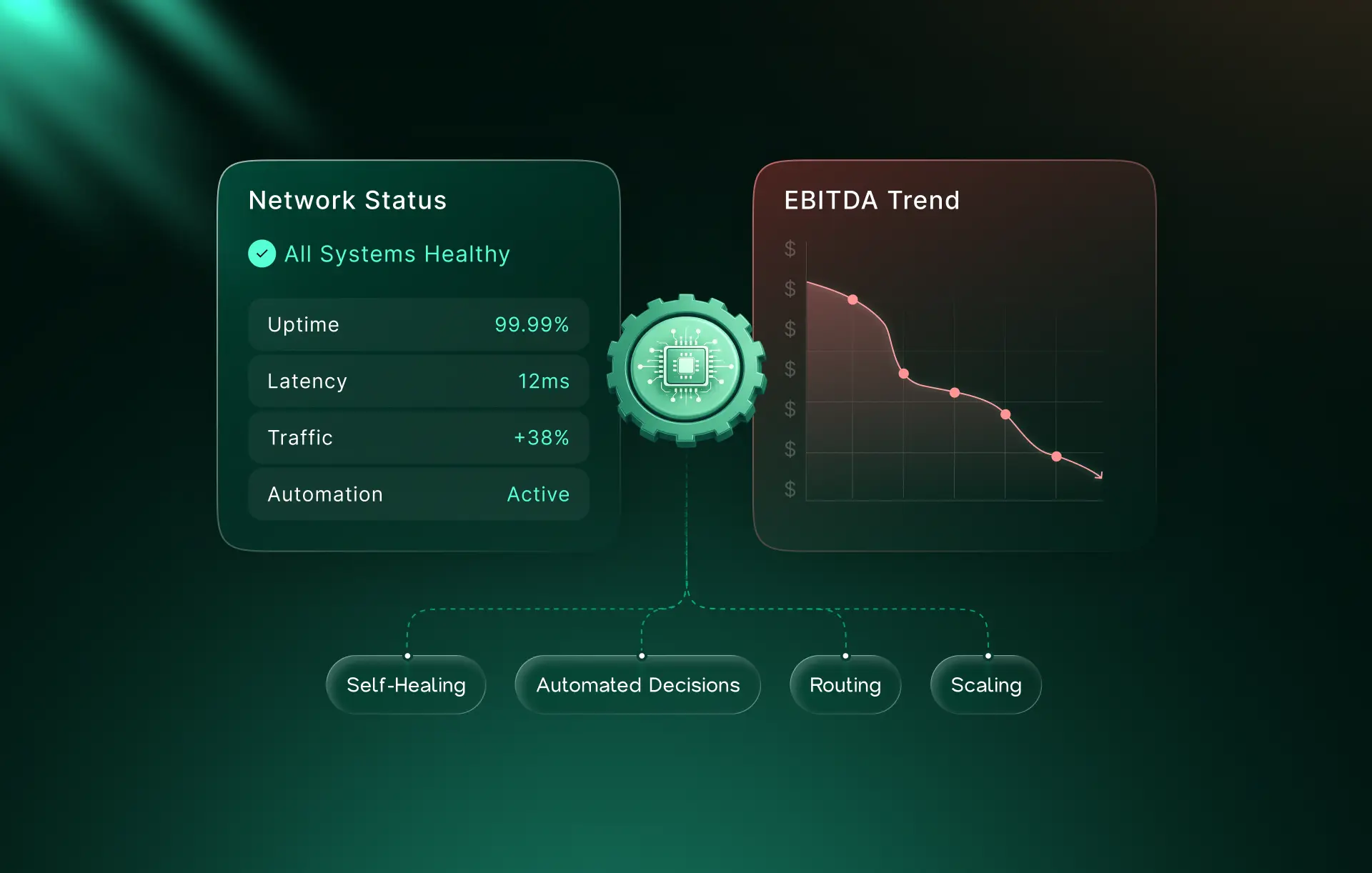



Predictability Is the Real Performance Metric
For years, telecom innovation has been measured by speed. Faster radios. Lower latency. Higher peak throughput. Each generation promised performance gains that looked impressive in controlled tests and launch presentations.
But at scale, networks are not judged by how fast they can go once.
They are judged by how consistently they behave when conditions are imperfect— a reality that places network performance predictability above raw benchmarks.
This is where many modern networks struggle — not because they lack capability, but because their behavior varies too much to be trusted by automated systems, commercial SLAs, and real-world operations.
Without telecom network predictability, even high-performing infrastructure becomes operationally fragile.
Why Speed Stops Matter at Scale?
Fast networks optimize for peak conditions.
Scaled networks operate under variability — the exact environment where predictable network behavior determines success or failure.
Traffic surges, handovers, congestion, policy conflicts, and energy constraints are not edge cases — they are the default state. When performance fluctuates unpredictably, operators compensate with manual intervention, conservative thresholds, and rigid controls that reduce efficiency.
Speed becomes irrelevant the moment stability disappears.
The Hidden Cost of Network Variance
Network variance doesn’t always cause outages.
It causes hesitation.
Automation pauses.
SLAs are padded.
Margins shrink quietly.
When systems cannot predict how the network will behave under load, operators are forced to design for worst-case scenarios. That leads to overprovisioning, excess energy consumption, and operational overhead that compounds over time — directly impacting efforts at scaling telecom networks sustainably.
Predictability, not raw performance, is what allows systems to trust themselves.
(Explore why long-term telecom scale depends more on adaptability than raw capacity expansion.)
Why Automation Depends on Behavioral Consistency?
Automation doesn’t fail because networks lack intelligence.
It fails because outcomes aren’t repeatable.
A self-healing workflow only works if similar conditions lead to similar responses. If latency spikes behave differently across regions, or handovers resolve inconsistently, automation becomes riskier than manual control.
This is why automation reliability in telecom networks depends less on advanced logic and more on stable, repeatable network behavior.
Predictable behavior is what turns automation from an experiment into infrastructure.
(See why automation only scales when network behavior is repeatable.)
SLAs Don’t Break on Speed — They Break on Variance
Most SLA violations don’t come from absolute performance limits.
They come from inconsistency.
Customers tolerate slower responses better than unstable ones.
Systems tolerate predictable degradation better than erratic behavior.
Networks that behave consistently under stress can offer tighter SLAs, more aggressive automation, and outcome-based pricing models without increasing risk — the foundation of true telecom SLA consistency.
What Operators Should Optimize First?
Before adding capacity, operators must stabilize behavior:
- Reduce performance variance across similar conditions
- Normalize responses during congestion and handovers
- Align orchestration decisions with repeatable outcomes
- Treat predictability as a first-class design goal
Fast networks impress.
Predictable networks scale.
(Understand why execution discipline matters more than speed.)
TelcoEdge Perspective
The next phase of telecom advantage will not be decided by who reaches the highest benchmark.
It will be decided by who builds systems that behave reliably under pressure — systems designed around telecom network predictability, not just speed.
At scale, predictability is what enables automation, protects margins, and sustains trust.