


Revenue assurance was designed for a different telecom era. An era where billing cycles were predictable, usage patterns were linear, and reconciliation volumes were manageable by human review.
That era no longer exists.
In 2026, modern telecom stacks process usage events at a velocity and granularity that traditional revenue assurance models were never built to handle. And as a result, revenue leakage has become less visible — and more structural. Not because operators lack controls. Because the architecture changed faster than assurance frameworks evolved.
1. CDR Volume Has Outpaced Human Oversight
A mid-sized MVNO serving 20–30K subscribers now processes between 3–6 million usage records per month, driven by 5G session-based charging, VoLTE traffic, IoT bursts, roaming micro-events, and cloud-native mediation pipelines.
At this scale, even a 1% variance in CDR reconciliation produces tens of thousands of misaligned records monthly.
These aren’t dramatic failures.
They are subtle mismatches:
- late-arriving wholesale records
- rating logic inconsistencies
- retry sessions that inflate rated usage
- partial reconciliations between mediation and billing
- rounding deltas between carrier and retail tariffs
Individually, they appear insignificant. Collectively, they create recurring monthly leakage. The problem is not volume alone. It is that oversight models remain largely retrospective and human-dependent. The reconciliation workload has grown exponentially. Human review capacity has not. This imbalance is where telecom revenue leakage begins.
2. OSS, BSS, and Billing Don’t Share Economic Context
Modern telecom stacks are modular. Carrier platforms optimize delivery. OSS optimizes performance. BSS optimizes billing logic. Each layer performs its role effectively. But they do not operate with shared economic awareness. When a routing decision is made in OSS, the system optimizes latency or throughput — not cost per session.
When billing rates usage, it applies predefined logic — without validating wholesale reconciliation impact in real time. When revenue assurance identifies discrepancies, it does so after billing cycles close. The systems are integrated technically. They are disconnected economically. This is why MVNO billing gaps persist even in highly automated environments. No single layer sees the full economic lifecycle of a session. (Discover why modern telecom operations demand fully modernized BSS architectures.)
3. The Cost of Delayed CDR Reconciliation
Traditional revenue assurance relies on:
- batch CDR comparisons
- periodic wholesale vs retail reconciliation
- offline dispute resolution
- month-end variance analysis
By the time discrepancies are identified:
- customers may have already been billed
- credits may have been issued
- disputes may have escalated
- operational teams may have absorbed manual correction cost
Industry research consistently shows telecom revenue leakage ranging from 1–3% annually. For MVNOs operating on compressed margins, that percentage can erase profitability. More critically, recovery rates decline sharply as detection is delayed. Once leakage becomes embedded in billing cycles and customer behavior, full recovery becomes operationally unrealistic. Revenue assurance becomes damage control. Not prevention.
4. Manual Revenue Assurance Masks Structural Issues
Manual reconciliation workflows often create a false sense of control. When discrepancies are identified, teams correct records, adjust invoices, and move forward. But corrections do not eliminate root causes. They normalize them.
Recurring CDR mismatch patterns become accepted operational noise. Credit adjustments become routine. Finance absorbs variance as part of business complexity. The system continues functioning. The leakage cycle continues monthly. Manual RA processes often measure recovery rates — not structural alignment. That distinction matters. Because recovering 40% of leakage still means 60% persists. (Explore how legacy telecom systems silently drive long-term operational cost.)
5. What “Economic Telemetry” Actually Means
Economic telemetry is not another dashboard metric. It is the ability for systems to understand the financial impact of operational decisions as they occur.
Today, networks measure:
- latency
- throughput
- session success
- SLA compliance
Very few measure:
- cost per routing decision
- margin per rated session
- variance between wholesale and retail charge in real time
- reconciliation drift under load
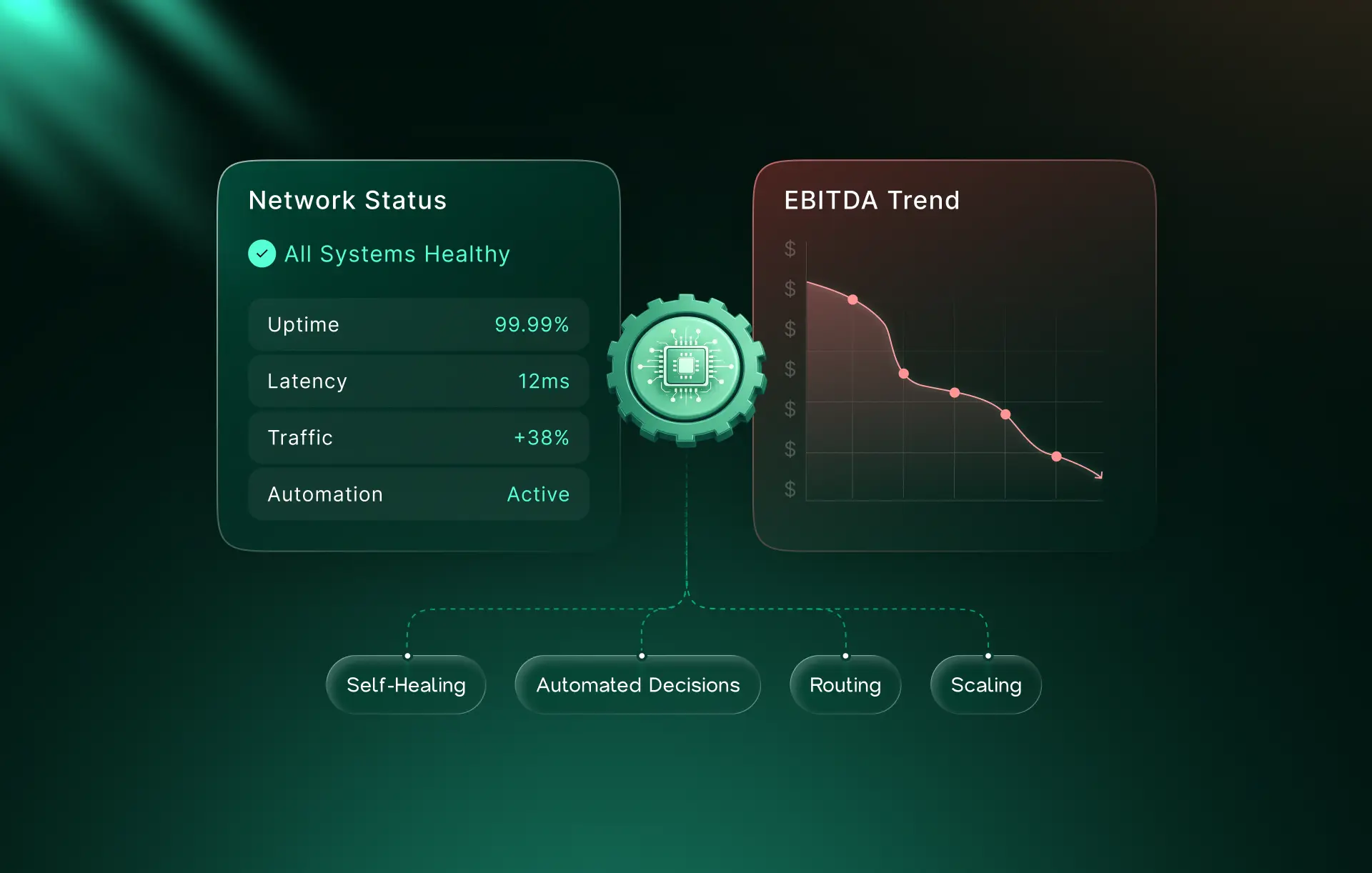
Without economic telemetry embedded into decision loops, automation optimizes performance without understanding profitability. This is why AI-driven OSS projects often improve efficiency metrics while margins remain flat or decline. Systems are intelligent. They are not economically aware.
6. Designing Closed Financial Loops
To reduce telecom revenue leakage, reconciliation must move from retrospective audit to continuous validation.
Closed financial loops require:
- real-time cross-validation of carrier CDRs and rated events
- dynamic margin verification before billing finalization
- automated anomaly detection tied to economic impact, not just volume
- feedback mechanisms that adjust operational logic when variance thresholds are crossed
In practical terms, this means usage, rating, billing, and financial validation cannot operate as separate workflows. They must operate as a synchronized system. Where discrepancies are identified before invoices are generated. Not after.
7. What Operators Must Re-architect
Revenue assurance in 2026 is no longer a compliance function. It is an architectural capability.
Operators must re-evaluate:
- whether CDR reconciliation occurs in real time or post-cycle
- whether OSS decisions consider wholesale exposure
- whether BSS platforms validate economic impact continuously
- whether automation amplifies performance without margin guardrails
The question is no longer whether revenue assurance automation exists. It is whether economic awareness is embedded into operational layers. Because telecom revenue leakage does not originate from outages. It originates from disconnected systems optimizing independently. Until economic context flows across OSS, BSS, billing, and mediation layers, leakage will remain structural. Not accidental. ( Learn what architecture modern telecom stacks require to scale reliably.)
The TelcoEdge Perspective
At TelcoEdge, we believe revenue assurance must evolve from retrospective reconciliation to real-time economic alignment. Modern telecom stacks require more than performance visibility. They require economic telemetry — the ability to measure what each decision costs before it compounds. Revenue does not disappear in modern networks. It drifts between layers. And the operators who close those gaps first will not simply reduce leakage. They will regain predictability in an industry where margin pressure is intensifying.