

Scaling Growth with MVNO IoT Connectivity and Automation
For years, MVNOs have been measured by SIM activations and subscriber growth. But in 2025, the real winners won’t be those who simply connect devices — it will be those who monetize MVNO IoT connectivity at scale.
From wearables to EV fleets, every device generates a constant stream of events. The real question: how do MVNOs turn that into ARR, not just bandwidth burn?
Why Must MVNOs Pivot Beyond Connectivity to Lead in IoT?
The IoT boom isn’t hype — it’s a trillion-dollar shift. By 2025, over 30 billion connected devices will be live worldwide. Unlike traditional consumer growth, IoT doesn’t scale by SIM count — it scales by events.
MVNOs who pivot beyond raw connectivity are already commanding 25% higher ARPU, because they’re delivering vertical-specific outcomes.
- eSIM onboarding for MVNOs and iSIM-based deployments simplify large-scale, secure rollouts.
- Real-time analytics enable vertical-aware plans for healthcare, logistics, and smart city operators.
- Cross-sector partnerships — from fleet to urban infrastructure — embed MVNOs into mission-critical industries.
IoT is not another subscriber race. It’s the new strategic battleground.

How Can Automation Help MVNOs Scale Beyond 1M Subscribers?
Legacy BSS/OSS stacks weren’t built for IoT economics. Manual operations collapse under millions of micro-events.
The MVNOs that break the 1M subscriber ceiling are those who’ve automated at scale:
- End-to-end automation across billing and provisioning, cutting OpEx by up to $30M.
- AI-driven ops: predictive churn, fraud detection, and dynamic plan adjustments. (explored further in our take on how AI drives telecom scalability)
- Rapid vertical launches — from months to weeks — through cloud-native MVNO automation.
A U.S. MVNO that migrated its stack fully to AWS achieved multimillion-dollar savings and became an attractive acquisition target.
Scaling IoT isn’t about more SIMs. It’s about invisible, automated operations.
What Role Does Platformisation Play in MVNO Differentiation?
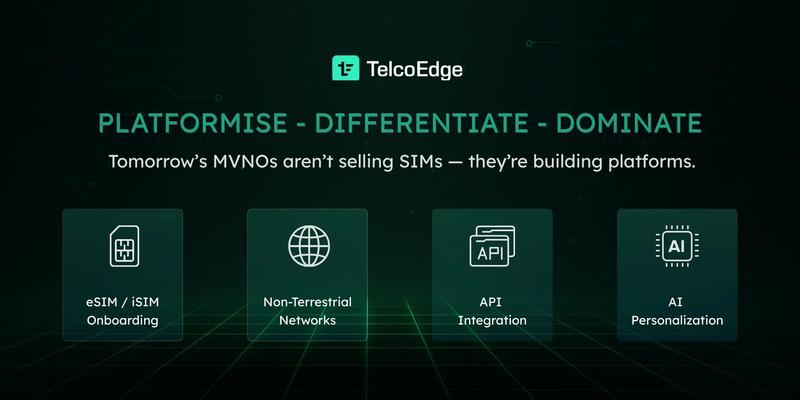
Tomorrow’s MVNOs aren’t selling SIMs. They’re building platforms.
- eSIM/iSIM onboarding unlocks instant global activation and borderless roaming.
- Non-terrestrial networks (NTN) like LEO satellites extend coverage to underserved regions.
- APIs enable cross-sector integration into fintech, ESG compliance, gaming, and health. (a shift we explored through the rise of API-first telco stacks)
- Hyper-personalized plans, powered by AI, boost retention and lifetime value.
Differentiation comes from becoming a platform, not just a provider.
Is Your MVNO Ready for 2025? A Quick Checklist
Ask yourself:
- Can your systems onboard millions of SIMs, eSIMs, and iSIMs automatically?
- Is your BSS/OSS cloud-native and API-first, ready for vertical expansion?
- Do you have real-time analytics to predict churn, detect fraud, and optimize offers?
- Are you investing in platformisation to move beyond connectivity into API-led monetization?
Takeaway
MVNOs who embrace automation, differentiation, and platformisation will define the next decade of telecom. At the center of this shift lies MVNO IoT connectivity, which powers the journey from simple SIM activation to scalable IoT monetization.
TelcoEdge acts as the control tower for ambitious operators — helping them turn legacy constraints into future-ready growth.
Interested in a teardown of your MVNO stack or the 2025 readiness checklist? Book a consult today.