

How MVNEs Simplify the MVNO Launch
Launching a Telco Is Hard—MVNEs Make It Simpler
Every MVNO founder eventually hits the same reality check: telecom is more complex than it looks.
You’re dealing with provisioning, billing, SIM management, compliance, CRM integrations, and technical onboarding—all before a single user signs up.
That’s where MVNEs for MVNO businesses come in. They don’t just provide infrastructure—they let you focus on building your brand while they handle the backend.
But how MVNEs help launch MVNOs—and what should you expect as you scale
What Does an MVNE Actually Do?
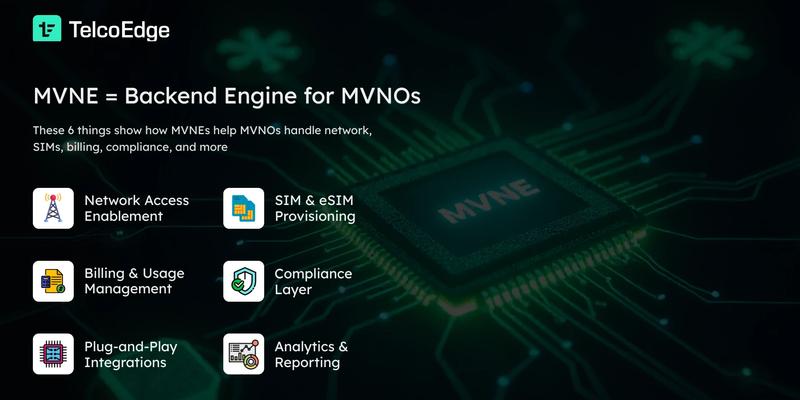
What does an MVNE do for MVNOs? MVNEs are the silent engines behind most MVNOs. Their job is to:
- Connect your MVNO to an MNO’s network infrastructure
- Handle provisioning (SIMs, eSIMs, number porting)
- Manage billing, activation, and real-time usage tracking
- Offer compliance tools for KYC, telecom taxes, and data privacy
- Provide pre-integrated support for payment gateways and CRMs
Think of an MVNE as the telecom backend-as-a-service. Without one, you’d be building your ops layer from scratch.
Why Most MVNOs Aren’t Ready to Build In-House
You might ask—why not just build all this internally?
Because it’s brutally hard, especially when:
- You’re launching with a lean team
- You’re not equipped to manage telecom-grade infrastructure
- You need to be live in weeks, not months
- You want to focus on brand, customer acquisition, and service design—not compliance logs and provisioning workflows
Most first-time MVNOs that attempt in-house ops eventually circle back to MVNE support. It’s not just about speed—it’s about sustainability. The benefits of using an MVNE become clear early in the journey.
When an MVNE Is the Right Choice
Choosing an MVNE makes the most sense when:
- You don’t have internal telecom infra or BSS/OSS capability
- You want faster time to market
- You need built-in compliance, provisioning, and billing
- Your differentiation is in brand, service, or UX—not infrastructure
MVNE vs MVNO is not a competition—it’s a collaboration. MVNEs are especially useful for:
- Retail brands entering telecom
- IoT service providers needing network capabilities
- Fintech or mobility apps adding SIM/eSIM bundles
- Global MVNOs needing scalable, modular backend support
MVNEs vs Modular Tech Stacks—What’s Changing?
The classic MVNE vs MVNO model is evolving.
Modern platforms now offer API-first approaches to telecom stacks, allowing MVNOs to mix and match modules—Checkout, CRM, Payments—without depending entirely on one MVNE.
Still, a strong MVNE partner gives you:
- A solid baseline for connectivity, billing, and compliance
- Faster iterations for product testing
- Fewer operational overheads in early stages
- Peace of mind when onboarding thousands of users
You can always modularize later. But at MVNO launch, simplification = survival.
Don’t Reinvent the Backbone
You didn’t start an MVNO to debug provisioning logic or patch a billing gateway.
You launched to build a brand, serve a community, or bring telco into a new vertical.
The benefits of using an MVNE let you do just that—without building everything from the ground up.
So if you're staring at a tangle of integrations, legal requirements, and launch delays...
👉 It might be time to stop patching. And start partnering.