


Why Continuity, Not Connectivity, Is the New Telecom Challenge?
Connectivity is no longer the part of the network operators struggle with—continuity is.
As 5G-Advanced, hybrid satellite models, and cloud-native architectures expand, networks behave less like static infrastructure and more like always-on digital ecosystems. With that shift comes a new reality: Opex is rising faster than revenue, outages are harder to predict, and orchestration workloads now exceed human capacity.
This is why 2026 marks the real inflection point for autonomous networks — an era increasingly shaped by Autonomous Network Orchestration
Not automated networks—autonomous ones.
Networks that perceive, decide, and act with minimal manual intervention.
Below is how autonomy reshapes Opex, outages, and orchestration for the next generation of operators
Why Are Operators Turning to Autonomous Networks in 2026?
Because the economics no longer add up without them.
Every wave of telecom innovation—LTE, 5G, now 5G-A—has introduced exponentially more complexity. More cells. More spectrum layers. More small-site densification. More non-terrestrial integration. Each upgrade improves capability, yet inflates operational intensity. Especially as Non-Terrestrial Networks (NTN) become mainstream.
Autonomous networks answer a structural problem:
Operators need a way to scale intelligence, without scaling headcount, support load, or engineering cost.
With AIOps for Telecom, that scaling finally becomes viable.
By embedding autonomous decision engines deep in the network fabric, operators shift from reactive operating models to self-directed systems that understand intent, not just data—laying the foundation for Intent-Based Networking (IBN) across the stack.
How Does Autonomy Reduce the Rising Opex Burden in 5G and 5G-A Networks?
The unexpected truth of 5G-A is that its greatest cost is not infrastructure, but operations.
Energy consumption alone can exceed 40% of Opex in dense deployments.
Manual monitoring and incident handling grow linearly with traffic load.
Spectrum utilization fluctuates unpredictably.
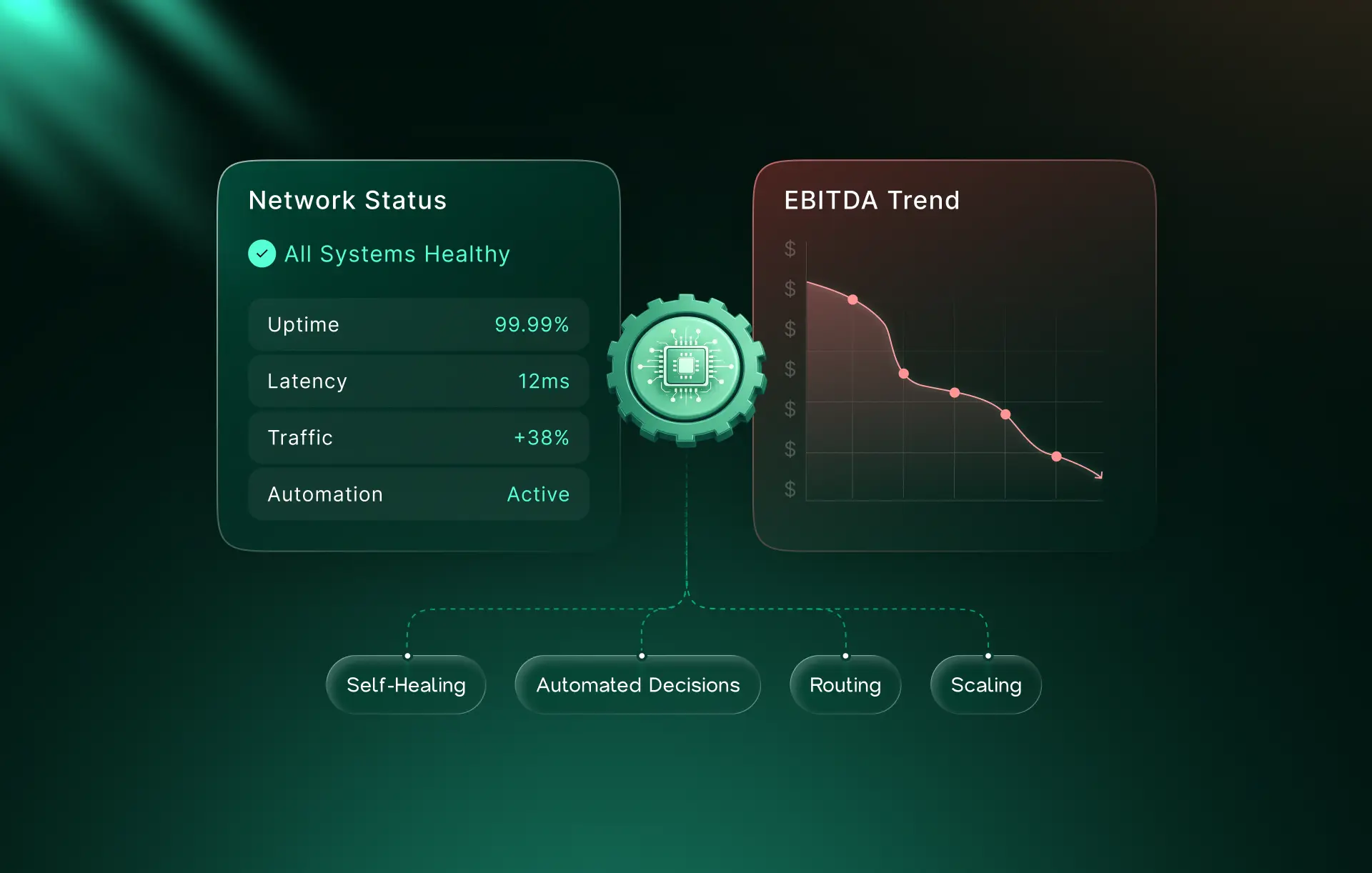
Autonomous networks break that cycle by making Opex elastic — an evolution accelerated by Zero-Touch Operations that eliminate repetitive manual tasks.
Instead of operating every node at peak capacity, autonomous layers continuously adjust energy consumption, antenna tilt, routing, and compute distribution in real time.
Unused resources scale down.
Hotspot areas scale up—without human intervention.
The outcome is not a marginal saving. Operators testing early autonomy report double-digit improvements in Opex efficiency because the network stops behaving like a static asset and starts behaving like an adaptive organism. (Explore how automation economics evolve when operations become self-adjusting.)
Can Autonomous Networks Actually Prevent Outages Before They Happen?
Yes—because outages have signatures long before they have symptoms.
Autonomous systems analyse thousands of micro-events per second: jitter anomalies, thermal drift, signaling congestion, packet re-transmissions, cluster imbalances. These are patterns that human teams rarely catch early enough.
With Generative AI for Network Ops, networks can simulate multiple remediation pathways and select optimal actions autonomously.
Instead of alerting after degradation, autonomous layers:
- identify deviation
- classify the risk
- assign a probable cause
- execute a corrective action
…in real time.
The difference is profound.
An automated network waits for thresholds.
An autonomous network predicts and corrects before thresholds even exist. (See how real-time, no-ticket remediation sets the foundation for autonomous correction.)
For operators, this means fewer escalations, fewer SLA breaches, and measurable improvement in customer lifetime value.
What Makes Autonomous Orchestration Different From Traditional Automation?
Automation handles tasks.
Orchestration coordinates workflows.
Autonomy makes decisions.
Autonomous orchestration is the moment the network stops needing instructions and begins writing its own playbook.
This evolution becomes even more powerful when combined with Agentic AI Networking, where AI agents independently optimise flows, detect anomalies, and prioritize services.
In traditional environments, engineering teams must specify rules, policies, escalation paths, and playbooks. But modern multi-layer networks generate too many scenarios for predefined scripts to handle.
Autonomous orchestration instead interprets context—who is moving, what service requires priority, what edge node is congested, what satellite beam is available—and selects the optimal sequence of actions without waiting for operator input.
This is how operators shift from “zero-touch provisioning” to zero-touch resolution.
How Do AI, Edge, and Cloud Combine to Make Networks Self-Managing?
Autonomy requires three ingredients working together:
- The edge provides proximity to events
- The cloud provides elasticity and scale
- AI provides decisioning
Edge nodes interpret conditions at millisecond timescales.
Cloud-native cores distribute workloads fluidly.
AI agents evaluate thousands of variables simultaneously.
As this architecture matures, operators increasingly rely on Network Digital Twin environments to simulate events, validate intent, and stress-test autonomous decisions before deploying them live through API integrations.
Together, they create a distributed intelligence fabric where decisions are made where the event happens, not miles away in a central system. (See why adaptability beats scale when intelligence moves to the edge.)
This distributed autonomy is what makes 2026 networks structurally different from their predecessors—responsive, contextual, and increasingly self-governing.
What Business Model Advantages Do Autonomous Networks Unlock for Operators?
The commercial transformation is as important as the technical one.
As networks become self-managing, operators unlock new monetization layers:
- reliability-based SLAs
- enterprise-grade autonomous routing services
- energy-optimized coverage contracts
- predictive QoS offerings
- autonomy-as-a-service for logistics, mobility, healthtech, and fintech
In each case, the revenue model shifts from selling bandwidth to selling outcomes: guaranteed uptime, assured routing, verified identity, predictive performance.
The operator stops being a connectivity provider and becomes a risk-reduction platform.
For enterprises, that distinction is worth paying for.
Are Global Operators Already Moving Toward Fully Autonomous Architectures?
The shift is already underway.
Operators in Asia, the Middle East, and Europe now run multi-city pilots that embed autonomous decision engines inside RAN, transport, and core layers. Early results show lower outages, faster recoveries, and materially lower Opex.
Software-driven telecom players—especially those leveraging cloud-native stacks—are proving that autonomy is not an experiment but a competitive advantage.
They configure new services faster.
They resolve network issues faster.
They operate with lower cost curves.
Autonomy is becoming the new spectrum: the differentiator only a few have mastered.
What Does an Autonomous Network Mean for Enterprises Relying on Telcos?
For enterprises, the shift is transformative.
A logistics company no longer gets “coverage”—it gets predictable routing intelligence.
A bank no longer gets generic connectivity—it gets autonomous identity assurance and risk-aware channel management.
A mobility provider no longer fears congestion—they get dynamic prioritization that adapts to fleet movement in real time.
Enterprises gain not just reliability—but network anticipation.
The network becomes an operational partner, not a passive transport layer.
How Will Autonomous Networks Reshape the Industry by 2026?
Telecom’s next decade won’t be defined by who deploys 5G-A fastest, who adds more cells, or who offers cheaper plans.
It will be defined by who builds networks that think.
Networks that anticipate.
Networks that self-correct.
Networks that allocate resources based on intent, not thresholds.
Autonomous networks turn infrastructure into a living system—lifting margins, reducing outages, and enabling business models that were impossible with manual operations.
The TelcoEdge Perspective
At TelcoEdge, autonomy isn’t a feature layer—it’s the operating model of the modern network.
We believe the networks that win in 2026 will be those that transform their intelligence into an asset, their orchestration into a capability, and their operations into a self-evolving system.
Autonomy is how telecom finally breaks free from linear costs and unlocks nonlinear scale.
Because networks weren’t built to be supervised forever—
they were built to learn their way forward.