

How to Expand Your MVNO Globally Without Breaking Ops
Growth Is Great—Until Ops Can’t Keep Up
Every MVNO wants to scale. Whether it’s launching in new markets or adding international user segments, global MVNO expansion feels like the natural next step.
But what often gets overlooked is the operational complexity that comes with it—regulatory requirements that shift by country, billing challenges in multiple currencies, and provisioning headaches that slow down onboarding.
This isn’t just a tech issue—it’s an infrastructure readiness test.
Here’s a practical breakdown of what MVNOs need to have in place before scaling across borders.
1. Make Payments Truly Borderless
Multi-Currency Billing Is Non-Negotiable
You can’t go global with a local billing mindset.
Supporting international MVNO launch means your payment infrastructure must adapt to each region’s currency, banking regulations, and preferred payment methods.
What that means:
- Multi-currency billing support for both customer payments and internal settlements
- Automated tax calculation based on geography and telecom-specific rules
- Cross-border payouts that don’t require complex reconciliation processes
- Flexible gateways (e.g., support for Apple Pay in Europe, UPI in India, etc.)
Checklist:
✅ Accept and settle in local currencies
✅ Handle telecom taxes per region
✅ Route payments to local gateways

2. Treat Compliance as a Built-In Layer
Telco Compliance by Geography Isn’t Optional
Telco regulations are not just technical—they’re legal. And they change country by country.
From KYC mandates to data residency laws, every new region introduces risk unless compliance is engineered into the operations layer.
Where MVNOs often struggle:
- Delayed onboarding due to manual KYC
- Tax miscalculations leading to regulatory fines
- Data privacy violations because of outdated infrastructure
Checklist:
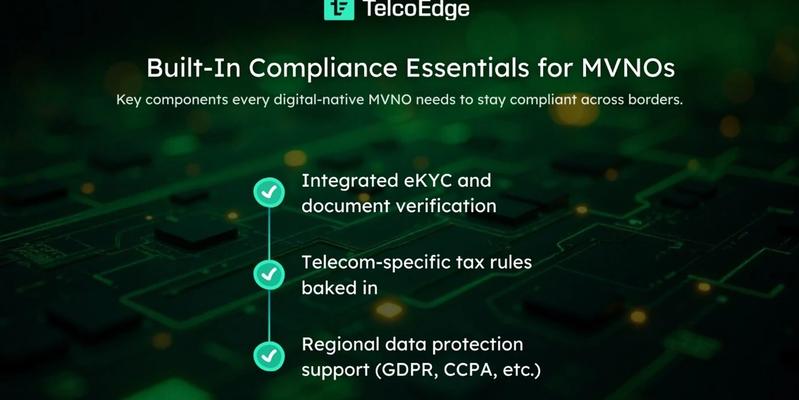
✅ Integrated eKYC and document verification
✅ Telecom-specific tax rules baked in
✅ Regional data protection support (GDPR, CCPA, etc.)
3. SIM and eSIM Provisioning Has to Scale with You
Cross-Border Telecom Operations Need Centralized Provisioning
Global MVNOs can’t rely on manual provisioning or local carrier workarounds.
Scaling across borders means automated SIM/eSIM onboarding, including carrier routing, number port-ins, and customer verification.
Provisioning must be centralized, fast, and customizable—regardless of the market.
Checklist
✅ Pre-integrated eSIM workflows
✅ Number porting tools per country
✅ Automated provisioning via API

4. Don’t Launch Without Multilingual, Omnichannel Support
Scalable MVNO Operations Require Localized Customer Support
International customers expect localized service, both in language and in the channels they prefer—be it WhatsApp in LATAM or SMS in Southeast Asia.
A scalable support strategy must combine automation, localization, and real-time responsiveness.
Where ops teams fall short:
- Single-language support limits expansion
- Support tickets delay activations and top-ups
- Chatbots with no telecom context fail to resolve common issues
Checklist:
✅ 24/7 multilingual support
✅ Channel flexibility (email, chat, SMS, app)
✅ Localized responses + self-service op
5. Analytics Should Help You Scale—Not Slow You Down
MVNO Global Strategy Needs Cross-Market Insights
As you expand, the need for visibility across markets becomes non-negotiable.
Without regional dashboards, segmented churn tracking, or performance snapshots by plan—you’re scaling blind.
Analytics should offer real-time insights that help operators spot trends, not just generate reports.
Checklist:
✅ Regional segmentation by plan/user type
✅ Real-time dashboards for usage + revenue
✅ Predictive churn and performance metrics
Global Growth Starts With Operational Clarity
Expanding your MVNO across regions is exciting—but only if your backend can support the complexity.
Before chasing growth, ensure your stack is ready for:
- Telecom compliance by geography
- Multi-currency billing and payouts
- Automated provisioning
- Localized customer support
- Cross-market analytics
The MVNOs that win globally aren’t the ones with the biggest plans—they’re the ones with the cleanest, smartest operations.